
What is a CEMA Loan in New York? A Guide to Mortgage Tax Savings

Nema Daghbandan, CEO
If you lend on New York real estate, you’ve likely run into the state’s Mortgage Recording Tax. It applies every time a new mortgage is recorded. But there’s a legal mechanism that can significantly reduce that cost on refinance transactions: the Consolidation, Extension, and Modification Agreement, or CEMA.
This guide covers what a CEMA is, why it exists, how the tax savings work, and how to structure one inside Lightning Docs.
Why Does New York Have a Mortgage Tax?
New York requires lenders to pay a percentage of the loan amount as a tax to the state whenever a mortgage is recorded. This is the Mortgage Recording Tax, and it’s actually a stack of components: a basic tax, a special additional tax, an additional tax, and in many jurisdictions, a local city or county tax layered on top. Because that local component is set jurisdiction by jurisdiction, and certain deductions apply specifically to one- and two-family residences, the effective rate can vary by both county and loan size.
The tax is calculated on new money only. If your loan is refinancing an existing mortgage, you don’t pay tax on the full new loan amount. You pay tax only on the difference between the unpaid balance of the existing loan and the new loan amount.
Consider an existing loan with an unpaid balance of $1,000,000. If the borrower refinances into a $1,500,000 loan, the Mortgage Recording Tax applies only to the additional $500,000, not the full $1.5 million.
Using the combined state-level rate of 1.00% (the basic, special additional, and additional taxes together, before any local add-on), the difference is significant:
- Without a CEMA: tax on the full $1,500,000 loan = $15,000
- With a CEMA: tax on the $500,000 Gap Amount only = $5,000
- Savings: $10,000
Local jurisdictions can add their own tax on top of this state-level rate, so the actual dollar savings on a given transaction will typically be higher. Rates are set jurisdiction by jurisdiction, so borrowers and lenders should confirm the current combined rate for the county where the property is located, and consult a New York-licensed attorney for guidance on a specific transaction.
What Is a CEMA?
A CEMA is the legal instrument that makes this tax treatment possible. Instead of satisfying the old mortgage and recording a brand new one, the new lender takes an assignment of the existing mortgage and then modifies it, effectively replacing its terms with those of the new loan.
Because the original mortgage lien is preserved and modified rather than discharged and replaced, only the new money advanced is subject to the recording tax.
A CEMA transaction can take one of two forms:
- With a Gap Amount. The new loan amount exceeds the unpaid balance of the existing loan or loans. The excess is referred to as the Gap Amount, or New Money.
- Without a Gap Amount. The new loan carries no additional advance beyond the existing unpaid balance.
In both cases, the underlying mechanism is the same: assignment and modification of the existing mortgage rather than a fresh recording.
How to Structure a CEMA in Lightning Docs
Lightning Docs supports CEMA transactions directly in the loan interview.
Step 1: Confirm New York collateral. As long as at least one property securing the loan is located in New York, the CEMA question becomes available in the Standard Loan Terms section.
Step 2: Answer “Is a CEMA required?” Select Yes, and Lightning Docs will prompt you for additional information.
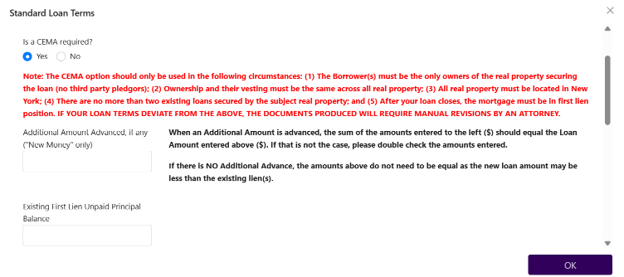
Step 3: Enter the existing loan balances. You’ll need the current, unpaid principal balance for up to two existing loans being consolidated.
Step 4: Enter the Gap Amount, if applicable. If the new loan’s principal balance exceeds the unpaid balance of the existing loan(s), enter the additional amount in the first box provided. This is the Gap Amount.
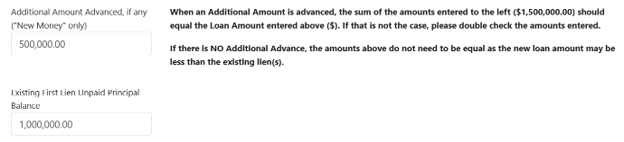
Step 5: Confirm the totals match. The total loan amount entered at the top of the page must equal the sum of the values entered in the CEMA section. Lightning Docs calculates the Gap as the difference between the current unpaid principal of the existing loan(s) and the new total loan amount.
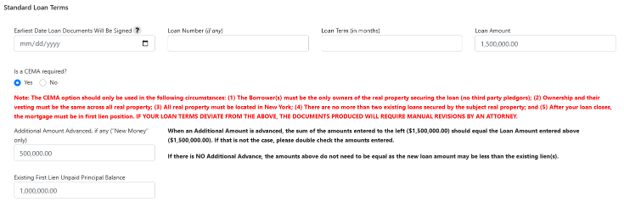
If there’s no additional advance, the new loan amount does not need to match the existing balance. It can be for a smaller amount than the loan(s) being consolidated.
What Documents Does a CEMA Package Include?
When a Gap Amount is entered, Lightning Docs generates two additional documents as a separately downloadable package:
- The Gap Note
- The Gap Mortgage
These documents represent the portion of the new loan that exceeds the original balance of the existing loan or loans.
The terms on the Gap Note are not necessarily identical to the terms of the overall new loan. This is intentional. The Gap Note functions as a placeholder and is superseded by the Consolidated and Restated Note, which governs the full, new loan amount going forward.
Frequently Asked Questions
What does "new money" mean in a CEMA transaction?
New money, also called the Gap Amount, is the portion of the new loan that exceeds the unpaid principal balance of the existing loan(s) being consolidated. This is the only amount subject to the Mortgage Recording Tax in a CEMA transaction.
Does the Mortgage Recording Tax rate change from county to county?
Yes. The tax has a base state-level rate, but many counties and New York City impose an additional local tax on top of it. The combined rate a specific transaction pays depends on where the property is located.
What if the new loan is smaller than the existing loan being consolidated?
A CEMA still works. If there’s no additional advance, the new loan amount doesn’t need to match the balance of the existing loan(s), and it can be for a smaller amount.
What documents come out of a CEMA transaction in Lightning Docs?
When a Gap Amount is entered, Lightning Docs produces a Gap Note and Gap Mortgage as a separate package, alongside the Consolidated and Restated Note that governs the full new loan amount.
The Bottom Line
For lenders and borrowers refinancing New York properties, a CEMA can mean substantial savings on the Mortgage Recording Tax. Lightning Docs builds the CEMA workflow directly into the loan interview, so consolidating existing debt, calculating the Gap Amount, and generating the Gap Note and Gap Mortgage all happen without leaving the platform.
Have questions about structuring a CEMA loan in Lightning Docs? Reach out to our support team at support@lightningdocs.ai.