
Key Markets Update: How Lending Activity is Concentrating in California, Texas, and Florida
Nema Daghbandan, CEO
California, Texas, and Florida are the three states driving much of Lightning Docs’ loan data, but through July 2026 they tell diverging lending stories. Nationally, bridge lending grew 9.4% year over year, while DSCR lending grew more than 35%, outpacing bridge loans for a second straight year. Underneath these national statistics, however, each of the three states is moving at a different pace.
Texas is the one to watch, growing faster than California or Florida across both loan types. California is still the heavyweight by volume, holding its position as the largest bridge lending market in the country and a top ten DSCR market as well. Florida, meanwhile, is working through a slower bridge lending stretch after a record-setting 2025, though its rates and DSCR loan amounts remain some of the most competitive across the nation. This report walks through bridge and DSCR loan volume, interest rates, and average loan amounts across all three states through July 2026.
Want the Full Picture?
The trends in this article are just a snapshot. The complete Lightning Docs Key States Market Report includes deeper, market-by-market detail for private lending professionals:
- Expanded Regional Breakdowns: State and metro-level data beyond the national averages shown in this article
- Above-Average Rate Markets: See exactly which regions are commanding higher interest rates, and why
- Above-Average Loan Amount Markets: Identify where deal sizes are outpacing the national norm
- Volume Heat Maps: Visualize lending activity concentration across the country at a glance
National Bridge Lending Rebounds After a Slow End to 2025
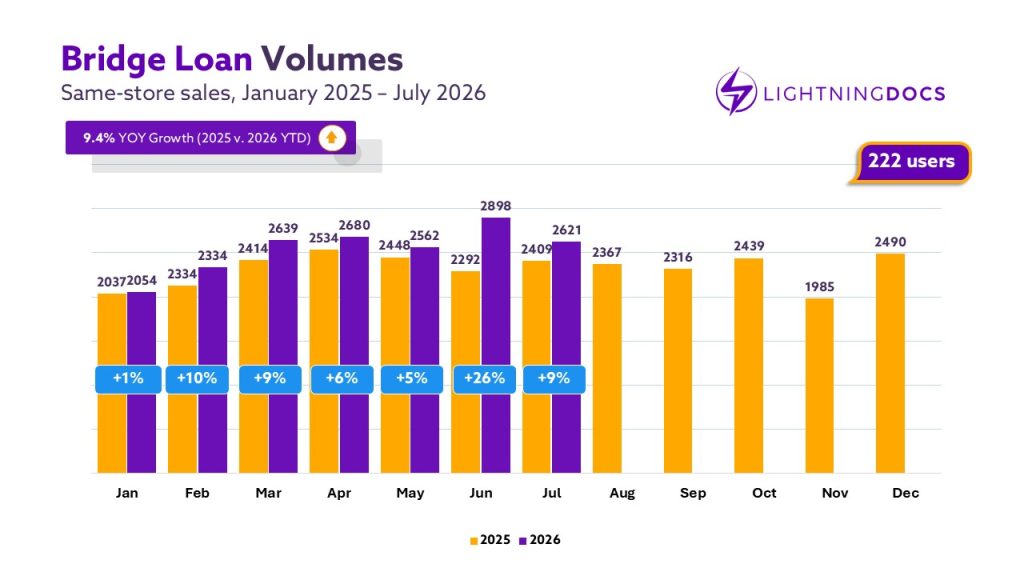
At a national level, bridge lending transaction volume has rebounded following a dropoff in growth at the end of 2025. Through July 2026, bridge lending posted stable year-over-year growth of 9.4%, with June standing out as the strongest month of the year at 26% growth over June 2025 (2,898 loans compared to 2,292). That volume remains heavily concentrated in California, Texas, and Florida, which continue to be the three largest states in the country for bridge lending by a wide margin.
California Bridge Lending Sets the National Pace
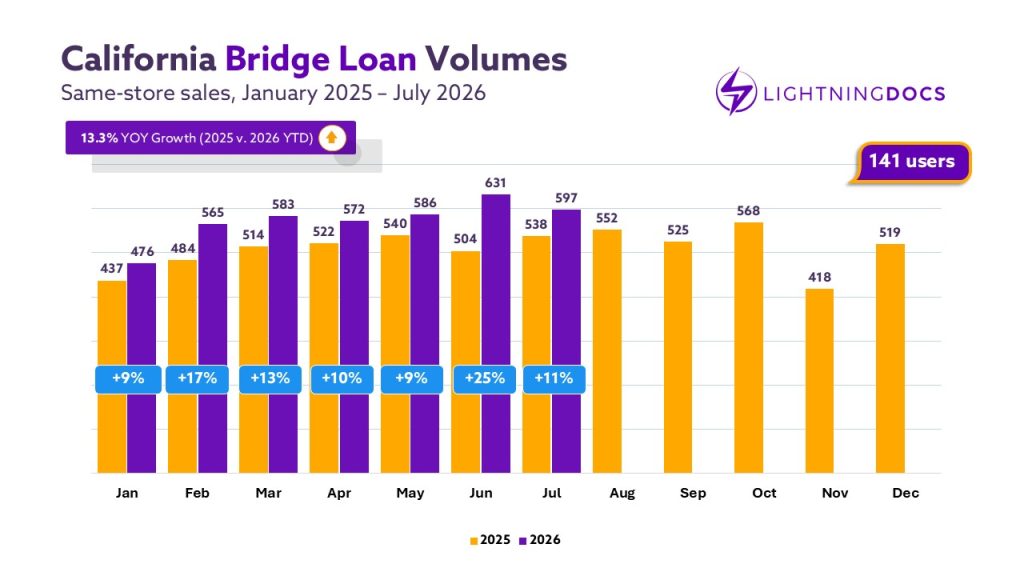
California remains by far the largest bridge lending state on Lightning Docs, and it followed the national pattern this year while maintaining stronger growth, up 13.3% year over year through July 2026. Even November, its slowest month over the past year at 418 bridge loans, still topped any single month recorded in Florida or Texas since the start of 2025.
Florida Bridge Lending Trudges Through a Slower 2026
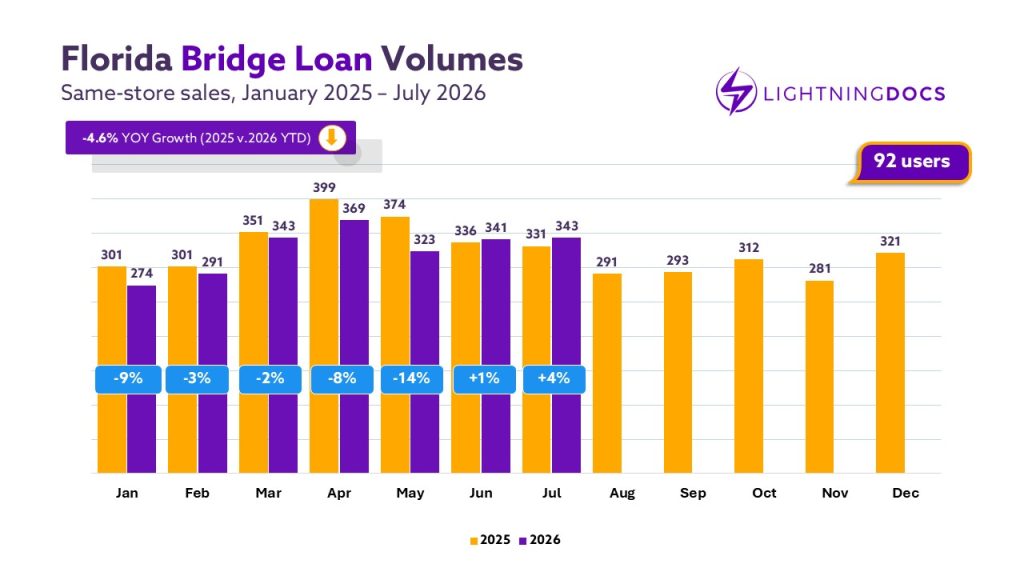
Florida has had a tougher time reversing its downward growth trend in bridge lending. Through the first five months of 2026, the state posted negative bridge loan growth year over year. Even with a return to positive growth in June and July, Florida remains down 4.6% for the year to date.
Texas Bridge Lending Emerges as a Fast-Growing Market
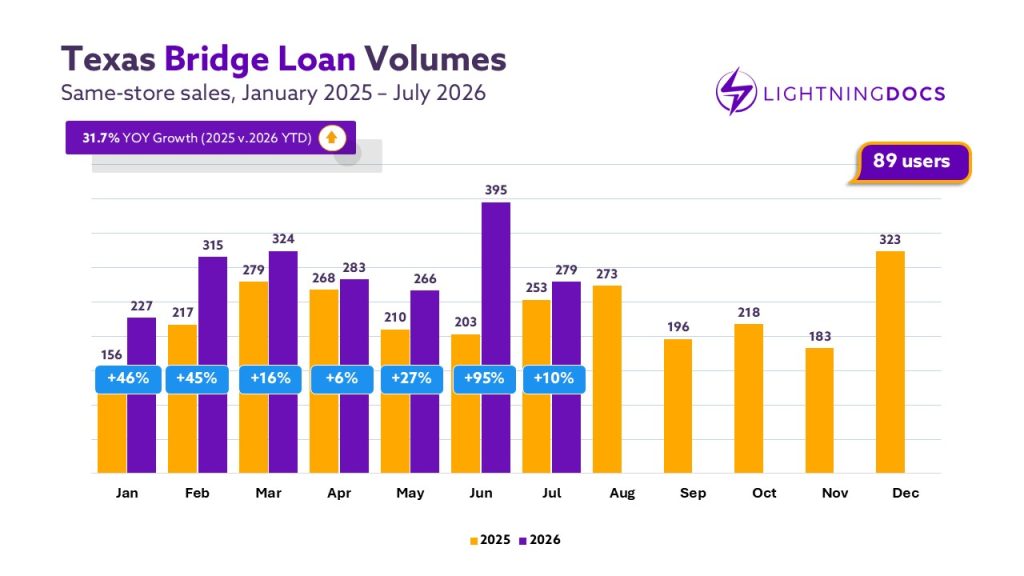
Texas, on the other hand, has been the largest driver of growth among these three states, up 31.7% year over year through July 2026. Apart from April, Texas hit double-digit growth every month, including a standout June in which 395 transactions produced a 95% year-over-year gain. This outpaced growth is largely driven by an increase in volume from Harris County (Houston), and the emergence of Bexar County (San Antonio) as a top 10 market nationally.
To see a free breakdown of the top counties across TX, CA, and FL you can request the full report here.
How Bridge Loan Interest Rates Compare in California, Florida, and Texas
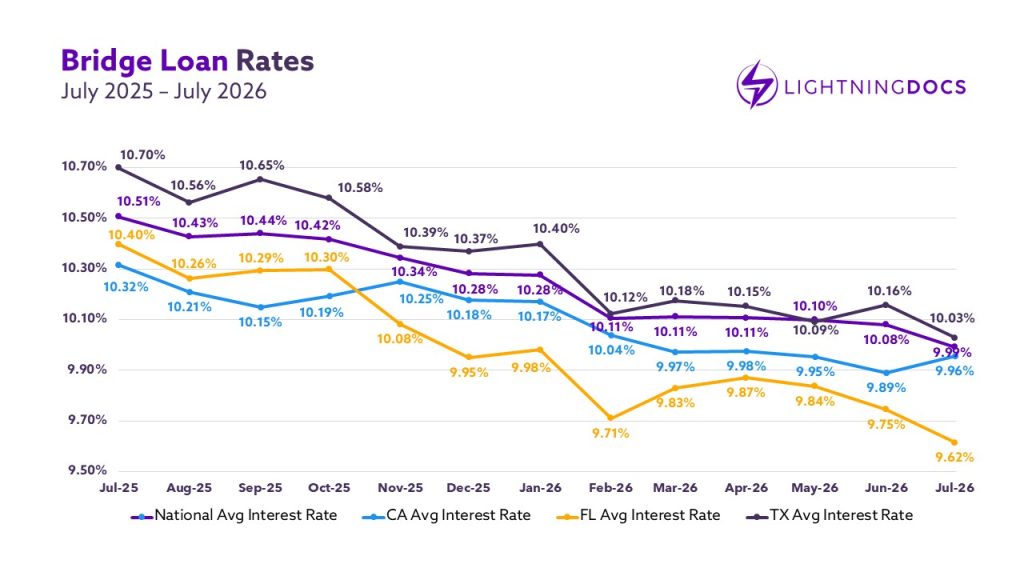
Bridge loan interest rates eased steadily across the country over the past year. The national average fell from 10.51% in July 2025 to 9.99% in July 2026, a decline of 52 basis points. California, Texas, and Florida moved in the same direction but at different speeds. Florida’s average rate dropped the most, down 78 basis points to 9.62% by July 2026. Texas fell 67 basis points to 10.03%, while California posted the smallest decline of the group at 36 basis points, ending the period at 9.96%.
How Bridge Loan Amount Averages are Moving in California, Florida, and Texas
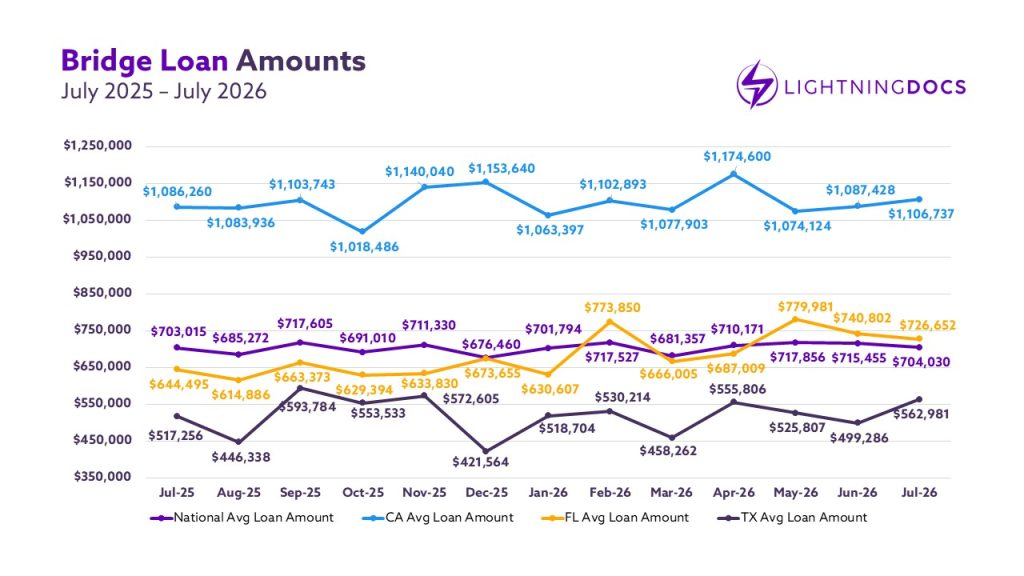
Of the three states, California carries the highest average bridge loan amounts, hovering around $1.1 million after peaking at $1.17 million in April 2026. These figures place the state in the top 2 for bridge loan amounts, second only to Arizona. Florida also cracks the national top ten with an average of $716,000 in 2026.
Compared to this time last year, both the national average and California’s average have moved very little, with the national figure essentially flat (up about 0.1%) and California up a modest 1.9%. Florida has increased 12.7% over the same span, with Texas posting an 8.9% increase respectively.
National DSCR Lending Growth Continues Steady Growth After Recent Surge
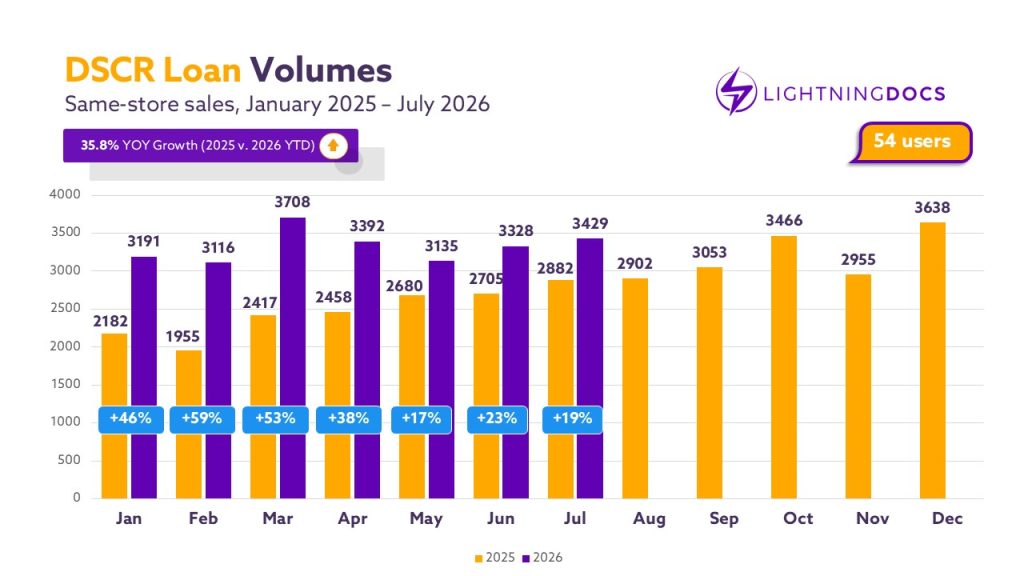
DSCR lending experienced extreme growth nationally throughout 2025, with transaction volume setting a new all-time high on Lightning Docs in nearly every month of the year. That pace has cooled in 2026, with only March setting a new record so far. Even so, DSCR lending is up more than 35% year over year through July 2026, well outpacing bridge lending’s 9.4% growth over the same period.
California DSCR Lending: Consistent Yearly Increases Belie Volatile Monthly Growth
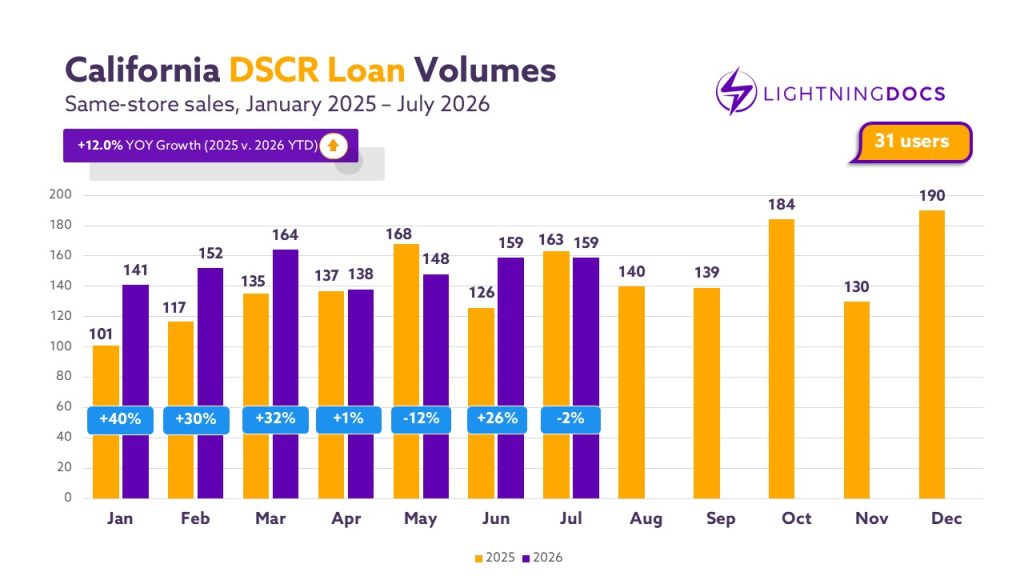
California, long viewed primarily as a bridge lending market, ranks seventh nationally for DSCR volume and remains a meaningful player in the space with 12.0% year-over-year growth through July 2026. The state posted double-digit growth in the first quarter of 2026, but that momentum stalled in April as the rise in interest rates meant that deals no longer penciled.
Since then, California’s DSCR volume has been uneven, including a low point of -12% year-over-year monthly growth in May, before rebounding alongside the national trend in a strong June. That volatility stands in contrast to the steadier climb the state built through 2025. It remains to be seen whether California’s more mercurial DSCR activity can solidify the state as a top market.
Florida DSCR Lending Cools from a Record 2025
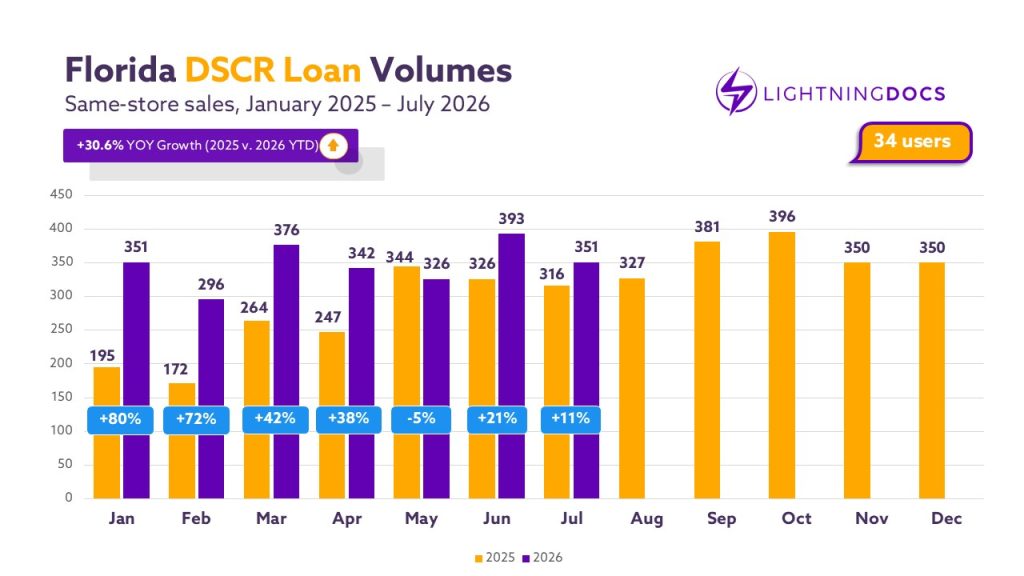
Florida carried its record 2025 DSCR growth into the first quarter of 2026, posting 80% and 72% year-over-year growth in January and February. May brought a sharp reversal, with volume down 5% year over year, before the state regained positive momentum in June and July. Florida’s DSCR volume is still up 30.6% year over year through July 2026 despite that dip, though the deceleration from early-year levels is at least partly a function of an unusually strong prior-year comparison: 2025’s high DSCR volumes on record raised the bar for growth in 2026.
Texas DSCR Lending Posts the Strongest Growth Among Key States
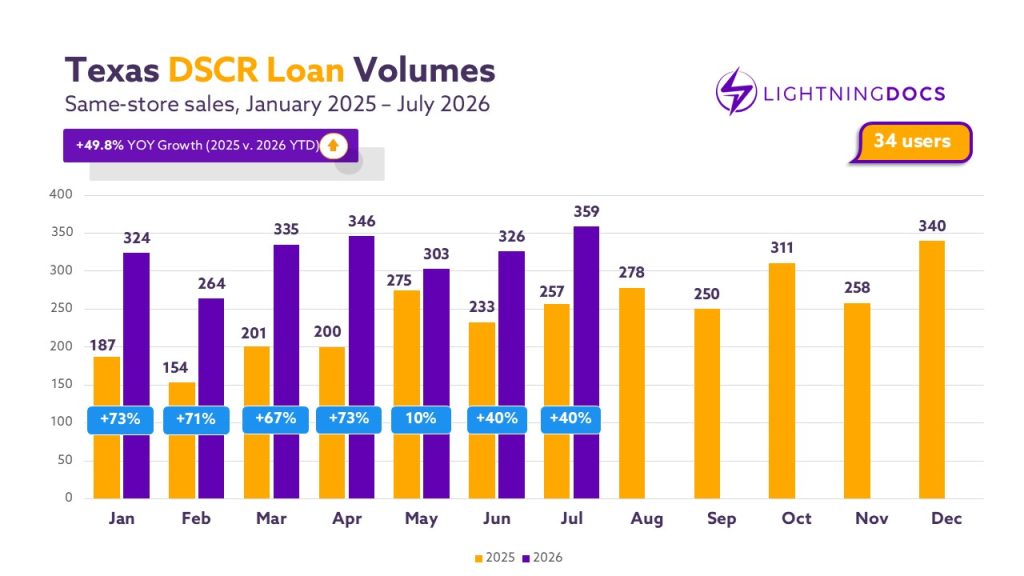
Texas has had the strongest DSCR year of any of these three markets, posting just under 50% year-over-year growth through July 2026. Even during the broader slowdown that hit all three states in May, Texas maintained double-digit growth, and it carried that strength into midyear with back-to-back 40% gains in June and July.
DSCR Interest Rates are Converging Across Markets
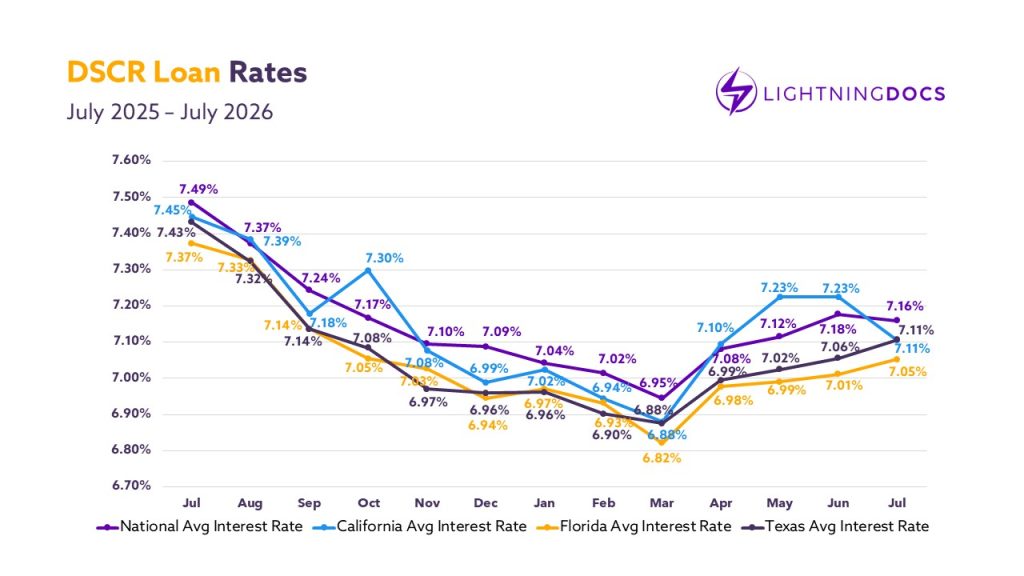
DSCR rates moved in a tighter band than bridge rates over the same period. Nationally, the average DSCR rate fell from 7.49% in July 2025 to 7.16% in July 2026, a decline of 33 basis points. California, Florida, and Texas all moved in near lockstep with the national trend, each falling roughly 32 to 34 basis points over the year. By July 2026, Florida held the lowest average DSCR rate of the group at 7.05%, followed by California and Texas at 7.11% each, with the national average at 7.16%. All three states finished the period below the national average, a sharper contrast to bridge lending, where rate spreads between states were considerably wider.
DSCR Loan Amounts Diverge as California Pulls Back and Florida Climbs
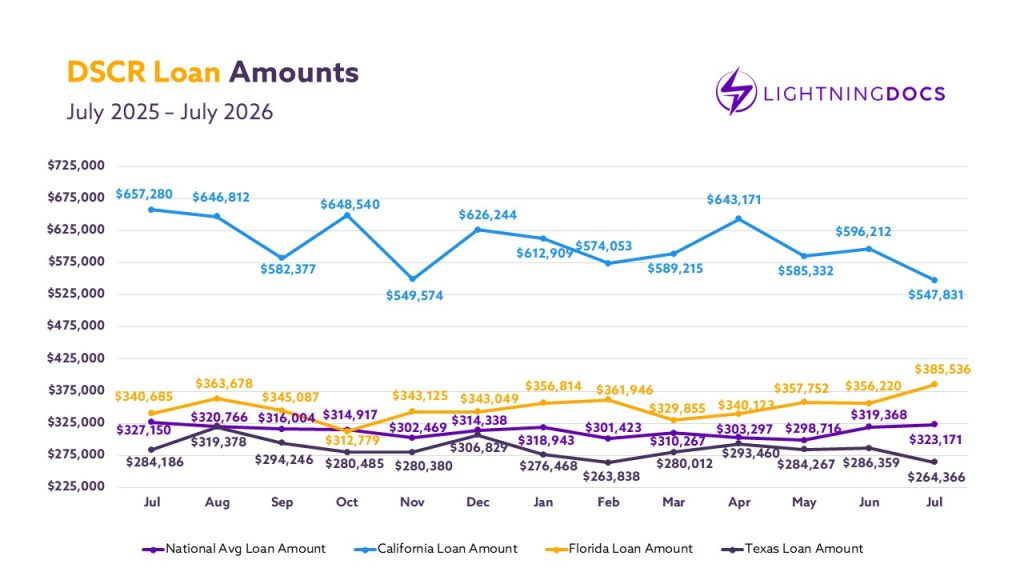
California continues to carry some of the highest average DSCR loan amounts in the country, trailing only Hawaii and New York for the year. Even so, the state’s average has pulled back sharply, down 16.7% over the past 12 months, a much steeper decline than the market has seen nationally or in its other top states. Texas has also dropped, down 7% over the same period, while Florida has moved in the opposite direction, up 13%. The national average, by comparison, has stayed close to flat, down just 1.2% from a year earlier.
Key Takeaways for Lenders in California, Texas, and Florida
California, Texas, and Florida comprise a strong subset of Lightning Docs’ private lending data, but the three states are no longer moving in unison. California continues to set the pace on combined scale across bridge and DSCR lending, even as its 2026 bridge growth trails the group and its DSCR loan amounts have pulled back the most of the three. Texas has emerged as the fastest-growing state across both loan types, driven in part by rising volume in Houston and San Antonio, while its lenders continue to work with average loan amounts well below the national figure. Florida sits in between, working through a slower stretch in bridge lending after a strong 2025, even as its average loan amounts and interest rates remain some of the most competitive in the country.
For lenders active in any of these markets, the data through July 2026 points to the same conclusion prior reports have shown: national private lending trends are, in large part, a reflection of what is happening in these three states, even as each now tells its own distinct story underneath the headline numbers.
To get a deeper breakdown by county across California, Texas, and Florida, request the free full data set to get the complete report delivered directly to your inbox.
Definitions
A bridge loan is any loan with a duration of 36 months or less utilizing interest-only payments for the duration of the term and containing a balloon payment at the end of the loan. Bridge loans are commonly referred to as residential transition loans (RTL), fix-and-flip, non-owner occupied, hard money, or in other terms that describe a short-term loan generally secured by a residential property for investment purposes.
DSCR loans are 30-year term loans secured by rental properties. DSCR stands for Debt Service Coverage Ratio, which identifies that the primary underwriting for these loans is done by dividing the monthly net operating income of the property by the monthly debt service.
A User refers to a unique company using the Lightning Docs platform. If multiple individuals within the same company access the platform, they are collectively counted as a single user.
Methodology
Loans below $50,000 and above $5,000,000 have been removed from the data set.
Loans with interest rates below 4% and above 20% have been removed from the data set.
For the loan volume slides, the user must have signed up with Lightning Docs prior to 2025.